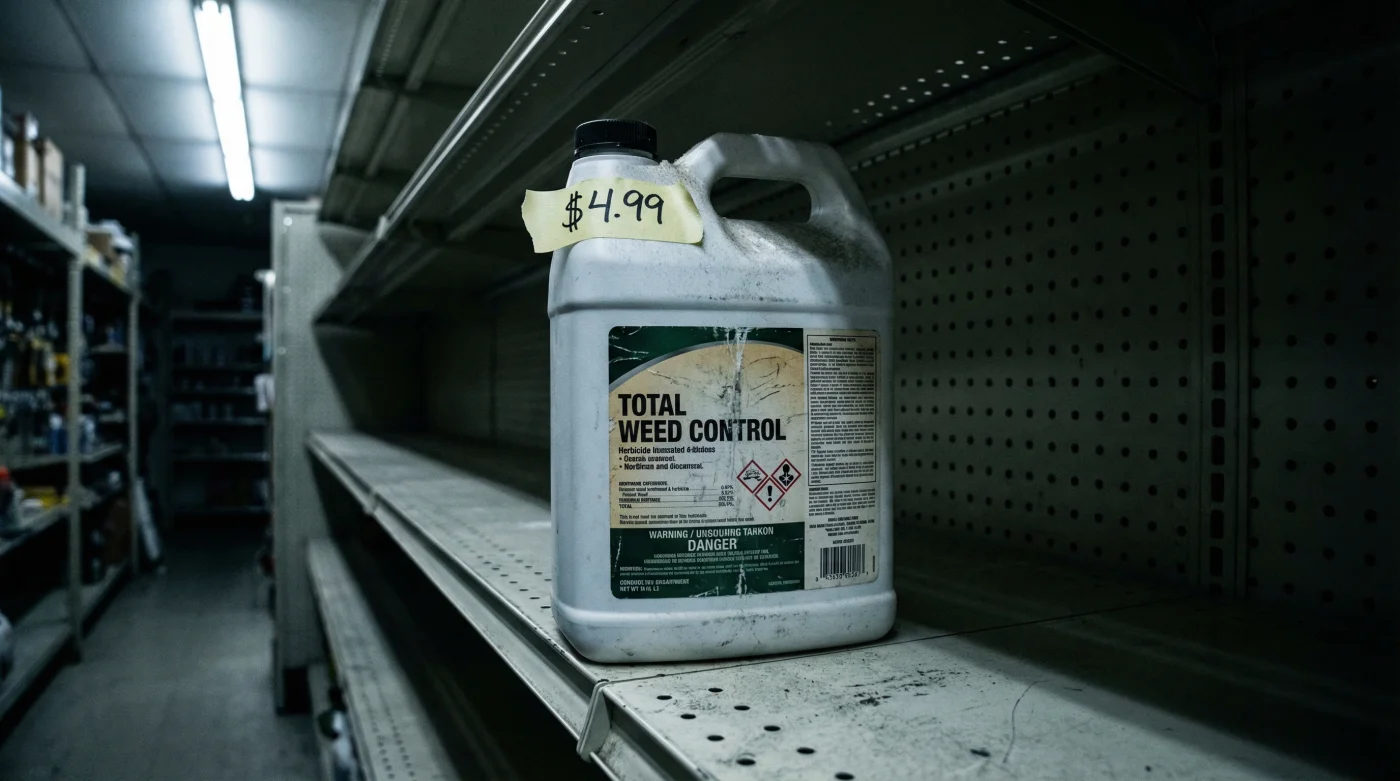
You pull into the hardware store parking lot on a crisp Saturday morning, the air already thick with the scent of pine mulch and damp soil. You walk the familiar concrete aisles, boots scuffing past the racks of rakes and hoses, heading straight for the garden chemical section. You know exactly what you need to reclaim the patio pavers before the afternoon barbecue. But where the wall of familiar white and yellow jugs used to stand, there is only a strange, reorganized gap. A quiet reshuffling has taken place while you were busy with the work week.
You scan the surrounding shelves, assuming a clerk just moved the heavy stock for a seasonal end-cap display. Instead, you find unfamiliar labels boasting about iron content and fatty acids, quietly taking up the prime real estate. The transition happened overnight, without flashing warning signs or public announcements at the register.
This silent departure isn’t a localized supply chain hiccup or a temporary backorder. Across the country, major retailers are quietly pulling Roundup from their shelves, bowing to a sudden wave of local retail bans and quiet corporate liability mandates. The heavy-handed chemical era of backyard maintenance is closing its doors, not with a televised bang, but with a calculated, corporate whisper. It leaves you standing in the aisle, wondering how to adapt your weekend chores to a suddenly altered landscape.
The Alchemy of the Empty Shelf
For decades, yard care relied on a simple, brute-force transaction: spray the green thing, watch it turn brown over a week, and walk away. But this sudden retail disappearance forces you to view your driveway cracks and garden borders entirely differently. You are no longer waging chemical warfare, but instead learning how the root system actually breathes and reacts to sudden stress.
Think of it like swapping a heavy sledgehammer for a surgical scalpel. The old glyphosate formulas acted as a systemic poison, slowly traveling down the vascular tissue to shut off the plant’s internal food factory. The new arrivals on the shelf—primarily iron-based and acidic formulas—work entirely on the surface. They rapidly oxidize the foliage, burning away the plant’s protective cuticles until it simply exhausts its energy reserves trying to push out new leaves.
Elias Vance, a 54-year-old municipal horticulturist out of Portland, saw the writing on the wall two years ago when city parks quietly scrubbed their inventory of traditional herbicides. ‘We panicked at first, hoarding the last jugs in the maintenance shed like liquid gold,’ he notes. But within a single growing season, he realized that switching to iron-based suppressants actually forced his grounds crew to pay closer attention to soil health, turning what felt like a frustrating institutional handicap into their greatest landscaping advantage.
Navigating the New Aisle
The phase-out timeline isn’t happening uniformly, which explains why your local store might look wildly different from one a county over. Depending on the micro-climate of your property and the specific tasks on your weekend list, you are likely facing one of three specific scenarios as you try to maintain your borders.
For the pavement purist trying to keep a long gravel driveway or a stamped concrete patio immaculate, the sudden absence of systemic weed killer feels like a mild crisis. To replicate that scorched-earth result, you will need to look for high-concentration acetic acid products, which act incredibly fast but require precise, midday sun exposure to truly strip the unwanted foliage of its waxy, moisture-retaining layer.
For the garden bed curator, the shift is actually a hidden blessing in disguise. The new Iron HEDTA solutions selectively target broadleaf weeds but generally leave your desired turf and native grasses untouched. You simply mist the offending dandelion or thistle, and within hours, the heavy iron dose overwhelms the weed’s cellular structure, turning it a crisp, brittle black while the surrounding soil simply absorbs the mineral as a mild nutrient.
- Birch plywood panels hide secretly inside the commercial flooring aisle
- Liquid starch seamlessly secures temporary fabric wallpaper over textured drywall
- Mineral oil instantly restores cast iron radiators without toxic fumes
- Dawn dish soap ruins granite countertops over three years
- Hardware stores quietly pull Roundup amid sudden local retail bans
The Tactical Mineral Swap
Transitioning away from systemic weed killers requires a complete rewiring of your Saturday morning routine. Because these new alternatives rely on rapid, localized cellular damage rather than root-deep poisoning, the environment around you dictates your success.
You cannot casually spray iron or acid in the cool twilight and expect a clear driveway by Monday morning. The new process demands intense heat, direct light, and a highly mindful approach to application.
- Apply only when the ambient temperature is steadily resting above 75 degrees Fahrenheit.
- Target the plant when the morning dew has entirely evaporated, allowing the heavy mineral solution to coat the leaves rather than bead off into the dirt.
- Walk backward slowly as you spray to avoid tracking the oxidized, staining minerals onto your pristine concrete paths or wooden decks.
- Plan to reapply exactly 48 hours later to immediately stress and burn the freshly sprouted survival leaves.
Your tactical toolkit requires an immediate upgrade to match these new compounds. Discard the leaky trigger bottles. You now need a dedicated, pressurized pump sprayer outfitted with a brass fan tip. This ensures a fine, suffocating mist rather than a heavy, wasteful stream, maximizing the delicate surface area contact needed for total mineral burnout.
Reclaiming the Soil
Stepping back to admire a freshly cleared patio feels fundamentally different when you know the soil beneath your boots isn’t carrying a lingering, invisible chemical burden. The quiet removal of these ubiquitous jugs from retail shelves forces a slower, more deliberate, and ultimately healthier interaction with the land you actively tend.
You stop viewing every stray clover or crabgrass sprout as an enemy to be eradicated at all costs. Instead, you begin seeing the yard as a living, reactive system. Embracing this sudden retail shift gives you the profound peace of mind that comes from working alongside the environment’s natural rhythms, rather than constantly trying to chemically overpower them.
‘The moment you stop relying on synthetic shortcuts, you start actually reading the landscape, anticipating the weeds before they even break the surface.’ — Elias Vance
| Key Point | Detail | Added Value for the Reader |
|---|---|---|
| Glyphosate Phase-Out | Major stores quietly replacing stock due to local bans. | Avoids wasted trips and helps you prepare for the new normal in lawn care. |
| Iron HEDTA Shift | New formulas use iron to rapidly oxidize broadleaf weeds. | Provides a fast-acting, soil-safe alternative that won’t harm surrounding turf. |
| Application Timing | Requires temperatures above 75 degrees and direct midday sun. | Saves you money and frustration by ensuring maximum effectiveness on the first spray. |
Navigating the Transition
Why is Roundup suddenly missing from my local store?
Retailers are proactively pulling it in response to a growing patchwork of local and municipal bans, opting for a quiet phase-out to avoid legal friction and changing consumer liabilities.Will the new iron-based alternatives stain my concrete?
Yes, heavy iron formulas can leave rust-colored marks on porous surfaces. You must spray carefully and rinse any accidental overspray off pavement immediately.Do acetic acid weed killers work on deep roots?
No. They act as a top-growth burn-down. You will need to reapply a few times to starve and exhaust the deep root system completely.Can I still use old bottles safely?
While technically legal to use up existing stock in most areas, transitioning now helps you learn the new application rhythms before you are forced to switch under pressure.Is dish soap still a good DIY additive?
A few drops of castile soap help new mineral formulas cling to waxy leaves, acting as a surfactant to ensure the solution doesn’t just bead up and roll off.