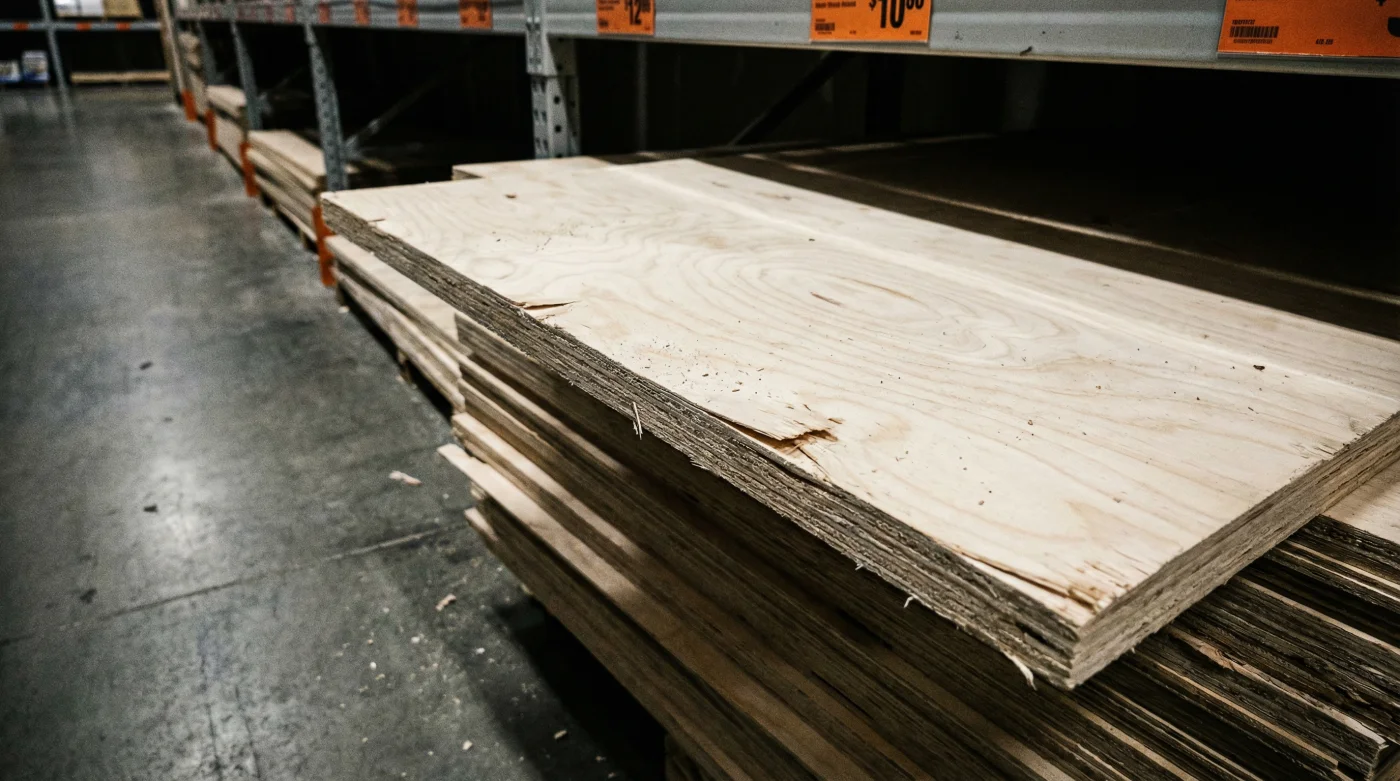
The scent of freshly milled pine and dried industrial adhesive greets you at the sliding automatic doors. You instinctively turn right, navigating your cart toward the towering racks of the finishing lumber aisle. Your hands graze the edges of the cabinet-grade birch plywood, feeling the rough patches and noticing the bowing warped corners. The price tags hanging below them tell a story of shrinking budgets and compromised project plans, often cresting eighty dollars for a single sheet.
You have been conditioned to accept this reality. You pay the premium or settle for construction-grade pine that splinters at the mere sight of a saw blade. The assumption is that building beautiful, lasting furniture means bracing yourself for punishing material costs, or driving forty miles to a boutique lumberyard that caters exclusively to professionals holding wholesale accounts.
But hardware store geography is a masterclass in misdirection. Just three aisles away, past the heavy machinery and the seasonal displays, sits the exact material you are desperately looking for. It is quietly stacked low to the ground, labeled under a completely different name, and priced at exactly half of what you were about to pay.
Manufactured to provide a perfectly smooth, void-free foundation for floors, these sheets boast the exact same premium birch veneer. The secret is flooring underlayment, and it costs exactly half of what you were about to pay in the lumber section.
The Geography Of Retail Illusion
Think of the hardware store not as a catalog of fixed materials, but as a map of isolated systems. We are trained to follow the literal signs overhead. If you want to build a shelf, you go to the shelving aisle. If you want wood, you go to the lumber department. This creates a kind of tunnel vision where we ignore the raw properties of the materials sitting right in front of us.
The shift happens when you stop reading the marketing labels and start inspecting the grain. Finding premium birch plywood hiding as subfloor material is a powerful act of material arbitrage. You are buying the physical reality of the wood, not the intended application. This thin, flawless panel was engineered to resist crushing under heavy foot traffic, meaning its inner core is completely solid, lacking the hidden empty gaps that ruin fine joinery.
By stepping out of the designated woodworking zone, you suddenly have access to a massive supply of high-grade, workable material. The price drops drastically simply because contractors buy this underlayment in massive bulk for messy jobs. The store assumes it will be hidden forever under carpet pads, so they do not bother applying the craftsman markup.
Consider Arthur Vance, a 62-year-old custom cabinet maker operating out of a cramped, dust-coated shop in Detroit. Decades ago, tired of losing his profit margins to volatile lumber prices, Arthur began browsing the commercial building sections. He noticed that a specific brand of quarter-inch flooring underlayment had a pristine birch face and a dense, uniform core. He bought ten sheets, built an entire run of mid-century modern drawer boxes, and never looked back. Today, his high-end clients run their hands over the butter-smooth, naturally finished drawer interiors, completely unaware they are admiring a material meant to live in the dark beneath a kitchen floor.
Grading Your Hidden Stash
Not all flooring materials are created equal, and pulling off this arbitrage requires a careful eye. Depending on your project, you will want to approach the stack with a specific set of criteria. The material is there, but you must become the final inspector.
For The Purist
If you are building fine boxes, cabinet backing, or anything where the wood will be stained and displayed, you need to dig through the pile. The faces of underlayment sheets are often marked with small ink stamps or faint scuffs from warehouse handling. Bring a damp rag to wipe away the warehouse dust and reveal the true color of the birch veneer. Look for tight, uniform grain lines that mimic the look of expensive Baltic birch.
For The Pragmatic Builder
When the goal is creating durable shop furniture, router jigs, or hidden structural supports, your standards can relax. Focus strictly on flatness. Because these panels are stored flat on the concrete floor, they are usually much straighter than the vertically racked lumber in the finishing aisle. Check the edges for any delamination where the glue layers might be separating, and grab the sheets that feel the most rigid.
For The Weekend Artist
Laser engravers and scroll saw enthusiasts know that internal voids are the enemy of delicate work. An empty pocket inside a plywood sheet will ruin a complex cut instantly. Flooring underlayment solves this completely. Because it must support the pinpoint pressure of high-heeled shoes without crushing, the inner core is completely solid. You can cut tiny, intricate patterns with total confidence.
Harvesting The Commercial Aisle
Sourcing and processing this material requires a deliberate approach. You are rescuing a fine material from a rough environment, so handle it with the care of a craftsman rather than a demolition crew. Keep your movements intentional, treating the thin sheets almost like carrying a large pane of glass.
- Inspect the edges first. A clean factory edge indicates the inner core is dense and well-glued.
- Check for the patch plugs. High-grade underlayment uses football-shaped wood patches rather than wood filler to fix knots.
- Support the entire sheet when moving it onto your cart. At a quarter-inch thick, it can bow and snap if carried solely by the middle.
- Wipe down both sides with mineral spirits before sanding to remove any industrial release agents from the factory press.
The tactical toolkit for this material is extremely minimal. Keep your blades sharp and prepare your cuts with blue painter’s tape to wrap the cutline and prevent the thin veneer from tearing out. A 60-tooth carbide blade will slice through the hardwood core like butter.
When finishing, use 150-grit sandpaper and move lightly. The top veneer is beautiful but incredibly thin; sanding it feels like wiping dust off a butterfly wing. Aggressive pressure will burn right through to the dark core, ruining the illusion completely.
The Confidence Of Resourcefulness
Walking out of the store with a stack of flawless birch panels for the price of a single sheet of traditional plywood changes how you approach your craft. It eliminates the hesitation entirely. When materials are prohibitively expensive, every cut feels like a high-stakes gamble. You measure five times, you sweat the angles, and sometimes, you avoid starting the project entirely out of fear of making a costly mistake.
Discovering material arbitrage gives you the freedom to experiment. You can build prototypes, test new joinery methods, and make mistakes without draining your bank account. This is the true value of looking past the labels. It shifts your focus away from the anxiety of the cost and places it firmly back onto the joy of the work itself.
You stop being a passive consumer of pre-packaged goods and become a true scout of materials. The entire world opens, revealing that high-quality resources are constantly hiding in plain sight, waiting for someone curious enough to turn them over and see their true potential.
“The label on the shelf tells you what the manufacturer intended, but the grain of the wood tells you what the material is truly capable of.” – Arthur Vance
| Key Point | Detail | Added Value for the Reader |
|---|---|---|
| Material Origin | Birch underlayment uses solid hardwood cores to prevent crushing. | Eliminates hidden voids that ruin joinery and laser cutting. |
| Cost Arbitrage | Priced for bulk commercial flooring contractors. | Saves up to 50% compared to traditional cabinet-grade plywood. |
| Storage Reality | Stored flat on pallets in the flooring aisle. | Dramatically reduces warping compared to vertically racked lumber. |
1. Will this underlayment take wood stain well? Yes, the top veneer is real birch and accepts oil and water-based stains beautifully once lightly sanded.
2. How thick is this material usually? It is almost exclusively found in 1/4 inch thicknesses, making it perfect for drawer bottoms and cabinet backs.
3. Can I use wood glue on the faces? Absolutely. Just wipe the surface with a damp cloth first to remove any warehouse dust or factory oils to ensure a strong bond.
4. Why does it have faint ink stamps on it? Manufacturers stamp grades and guidelines for flooring installers. A light pass with 150-grit sandpaper will usually remove them effortlessly.
5. Does it warp when cut into smaller pieces? Because the core is dense and cross-banded, it remains remarkably stable and flat even when ripped down into narrow strips.